

WHAT DOES IT FEEL LIKE?
THE SYMPTOMS
SYMPTOMS ARE SIGNS OR CLUES FROM THE BODY
When it comes to Chronic Hand Eczema, symptoms might include things like itch, pain, burning and stinging.1 These symptoms can come and go.2

THE WAY WE TOUCH PEOPLE OR HANDLE
OBJECTS IS AFFECTED IN SOME WAY FOR AROUND 3 IN EVERY 4 PEOPLE LIVING WITH HAND ECZEMA*3
Flare-ups and triggers
The symptoms of Chronic Hand Eczema can change over time, sometimes getting better and then worse again. Times when symptoms are worse are called ‘flares’ or ‘flare-ups’.4,5

This is when eczema gets worse suddenly. It might become more itchy, painful, red/darker and swollen.4–6 Managing Chronic Hand Eczema involves trying to stop flares from happening.
Experiencing flares, especially while already getting treatment for Chronic Hand Eczema, can be a sign to see your Doctor or GP to discuss to see what else can be done.3,7–10
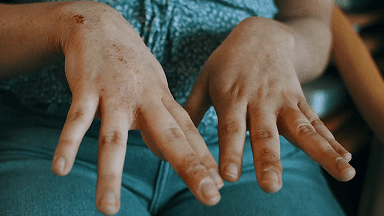
“WHEN I HAVE A FLARE-UP ON MY HANDS,
I REALLY DON’T WANT ANYONE TO TOUCH ME, I DON’T WANT THEM TO COME NEAR MY HANDS….”
Emma, a real patient with CHE
7/10 PEOPLE WITH HAND ECZEMA HAVE
COVERED THEIR HANDS BECAUSE OF SHAME
OR PHYSICAL PAIN*3
Flare-ups can sometimes happen when someone comes into contact with triggers.4
Triggers are things that can lead to an eczema flare-up. Finding out what things could make Chronic Hand Eczema worse and staying away from them as much as possible could be useful.1,10,11
Triggers can be different for everyone, but might include things like:
SOAPS4
CHEMICALS4
WET WORK1

ALCOHOL12
SMOKING1,13
RUBBER1,14

FOODS14

METALS1,14
STRESS4,12
FREQUENT HAND WASHING4
COLD OR WARM TEMPERATURES4

HORMONAL CHANGES12
CHRONIC HAND ECZEMA MIGHT NOT COMPLETELY GO AWAY FOR EVERYONE, BUT HAVING THE SUPPORT OF A DERMATOLOGIST THROUGHOUT CAN BE HELPFUL FOR MANY8,12
*This study involved a survey with questions about hand eczema’s demographics and psychosocial impact. It was completed by 1023 patients with hand eczema.3
RELATED CONTENT

LIVING WITH CHRONIC HAND ECZEMA

FINDING THE RIGHT SUPPORT AND TOOLS

WHAT DOES IT FEEL LIKE? THE SYMPTOMS
References
MAT-87568
- Thyssen JP, et al. Contact Dermatitis. 2022;86(5):357–78.
- NHS. Atopic Eczema. Available at: https://www.nhs.uk/conditions/atopic-eczema/ (Accessed September 2025).
- Ahmed A, et al. Clin Exp Dermatol. 2015;40(5):495–501.
- Grant L, et al. Adv Ther. 2020;37(2):692–706.
- Agner T and Elsner P. J Eur Acad Dermatol Venereol. 2020;34 Suppl 1:4–12.
- National Eczema Association. Eczema in Skin of Color: What You Need to Know. Available at: https://nationaleczema.org/blog/eczema-in-skin-of-color/#:~:text=Most%20people%20think%20of%20eczema,differently%20in%20darker%20skin%20tones. (Accessed September 2025).
- Giménez-Arnau AM, et al. Poster presentation at ESCD, 2024. Poster presentation #27.
- Rönsch H, et al. J Eur Acad Dermatol Venereol. 2023;37(7):1396–405. Erratum in: J Eur Acad Dermatol Venereol. 2024;38(8):1662.
- Borg E, et al. Contact Dermatitis. 2024;90(4):365–71.
- Weidinger S and Novak N. Lancet. 2024;404(10470):2476–86.
- National Eczema Society. Triggers for eczema. Available at: https://eczema.org/information-and-advice/ triggers-for-eczema/ (Accessed September 2025).
- Ghio D, et al. Br J Dermatol. 2020;182(1):112–8.
- Bauer A, et al. J Dtsch Dermatol Ges. 2023;21(9):1054–74.
- Diepgen TL, et al. J Dtsch Dermatol Ges. 2015;13(1):e1–22.